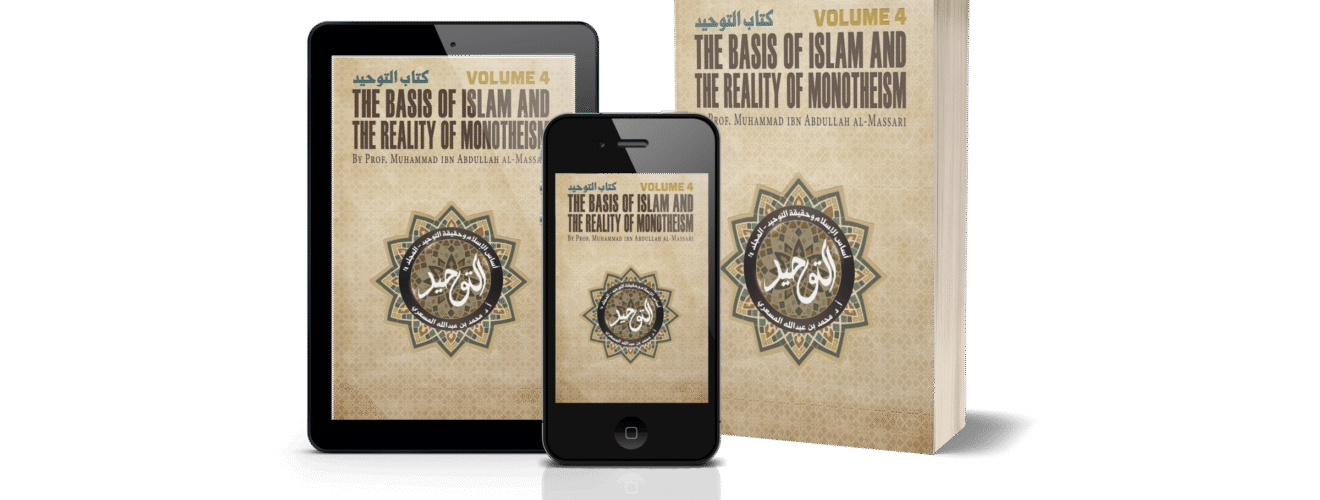
Kitab al-Tawheed Volume 4
Getting your Trinity Audio player ready...
|
Kitāb al-Tawḥeed: The Basis of Islam and the Reality of Monotheism, is truly a landmark work, occupying a unique place amongst a contemporary landscape often bereft of original insightful scholarly work. The series represents an in-depth study into the very root origins of Islam, the essential nature of Tawḥeed (monotheism). Coupled with that, it tackles head on not only the age-old problem concerning the precise nature of Shirk (polytheism) and worship, but how these topics invariably correspond to contemporary issues like ruling, governance and allegiance. Volume 4 concludes the series of books that we have translated into English. Previous volumes 1 through to 3 are open access on the website here, but also available in paperback and Kindle versions.
Last in the series: Volume 4
The translated English edition of this last concluding volume to the Tawḥeed series, the present volume covers Parts XI and X of the original Arabic. This volume begins by covering Tawḥeed as it pertains to al-Ḥākimiyyah wal’Tashrih’ – governance, legislation and the ultimate prerogative of command. The chapters outline in studious detail that Allah the Exalted alone, with no partner whatsoever possesses the exclusive right over legislation, independently and originally. Stated differently, He alone has prerogative of command. He the Exalted and Majestic, retains the ultimate and supreme authority as it relates to commandment and prohibition; He is the sole sovereign in all of these matters.
Stemming from this, the Professor outlines each of that facets that arise from this core premise, covering the verses of ruling in the Qur’an; the commandments to adhere to the rulings of the Sharī’ah in ruling, and how that it is actualised in political governance. Although not a topic which isn’t necessarily a mainstream of current discourse, detailed chapters are covered which delineate the bounds of political authority, which under the Sharī’ah are not as many think unlimited. Obedience to political authority is not without any qualification, those qualifications are specifically set by the Islamic evidences, including removal from office.
Returning full circle to the historically difficult topics upon the nature of Shirk and ‘Ibādah (worship), Part X covers matters relating to the contemporary obsession and phantasms over ‘graves,’ acts as being worship in and of themselves, intermediaries, as well as the nature of duʿā (supplication) according to the Islamic evidences. The remainder chapters revisit again topics raised earlier in Volume 2, correcting the historical blunders made in this area.

This is some of the wisdom your Lord has revealed to you: do not set up another god beside Allah, or you will be thrown into Hell, blamed and rejected [17: 39]
Structural changes
In tandem with our approach to each book in this series, we have streamlined many chapters, starting from the chapter titles. Repetitions have been significant curtailed, on occasion, omitted altogether. This departs from the original Arabic text, especially with regards to quotations from scholarly authorities, which are repeated throughout chapters. Although not part of the original Arabic text, we have included accompanying footnotes, together with additional clarification where appropriate. The footnotes have also been utilised to summarise the textual referencing. We have also utilised English translations of cited works where they are available. Additional topics arising from this series of books, including any standalone chapter appendices will be published as separate items here in due course.
Links to the Paperback copy and Kindle
We ask Allah for His help, support and guidance and to forgive our many mistakes and shortcomings. Perhaps Kitāb al-Tawḥeed as a four-part series of books will be of benefit to you as well as us, both in this present temporal plain, and the in the life to come, Ameen Ya Rab.
Volume 4 of the series is now published – available in paperback as well as Kindle. Given that censorship is becoming an increasing feature of life, we would encourage our readership to purchase the physical copies of the book and not to rely solely on open access versions.
Open Access
Included here is the open access version of the book, available for download via the link below. However, given its size and complexity, we would encourage purchase as per the links above.
Click the cover to view: